The Rendlesham Forest Incident: What the Tape and the Memo Actually Show
Two days before the video. On video launch day, update this post: add the YouTube embed in the “Watch the episode” section, check the article link is live, and add the article URL to the video description.
The Rendlesham Forest incident is a series of reported lights and an unidentified object seen by United States Air Force personnel near RAF Woodbridge in Suffolk, England, over the nights of 26 and 28 December 1980. What physically survives from those nights is unusually specific — a live audio recording made in the forest and an official memorandum written two weeks later — and, just as importantly, what does not survive: there is no authenticated photograph of the object at all.
That gap between two modest documents and a very large legend is the real story. Read in order, the documents from 1980 and early 1981 tell a strange, unresolved story. Read together with everything added in the decades that followed, they tell a different one. This article keeps the two apart, dates every later claim, and labels it as a claim — so you can see exactly where the record ends and the retelling begins.
KEY FACTS — RENDLESHAM FOREST INCIDENTDates: Nights of 26 December 1980 and 28 December 1980 (the official memo misdates both by one day — see below).Location: Rendlesham Forest, near the East Gate of RAF Woodbridge, Suffolk, England. RAF Bentwaters was the twin base nearby.Who reported it: U.S. Air Force security personnel on patrol, and, on the second night, the deputy base commander, Lt. Col. Charles Halt.What survives: (1) The Halt Tape — audio Halt recorded live in the forest on a microcassette recorder on the second night. (2) The Halt Memo — “Unexplained Lights,” dated 13 January 1981, now at The National Archives, reference DEFE 24/1948.What does not exist: No authenticated photograph of the reported object has ever been produced.Official status: The Ministry of Defence stated it assessed no threat to national security. The case itself remains unexplained — which is not the same as explained, in either direction.
What happened on the first night — 26 December 1980
In the early hours of 26 December 1980, a security patrol near the East Gate of RAF Woodbridge reported lights descending into Rendlesham Forest. The patrolmen named in the contemporary accounts include John Burroughs, Jim Penniston and Edward Cabansag. [WITNESS ACCOUNT] They reported a glowing object in a clearing, lights moving among the trees, and a disturbance among farm animals nearby.
What matters for a careful reader is the sequence. The first reports were made at the time, by named personnel, through a military chain of command — not reconstructed for a book years later. That does not make every detail in them correct. It does make them different in kind from accounts that first appeared decades afterwards, and this article treats them differently for exactly that reason.
When the site was examined in daylight, personnel reported three depressions or marks in the ground in the clearing, along with possible traces on nearby trees. [FACT — as recorded at the time] Ground traces were noted and photographed as a scene, even though the object itself was not. Local forester Vince Thurkettle later offered a mundane reading of similar marks in that working forest — a point weighed in the explanations section below — but the traces belong to the contemporary record, not to the later legend.
The second night and the tape — 28 December 1980
Two nights later, lights were reported again. This time the deputy base commander himself went into the forest. Lt. Col. Charles Halt took a team out to investigate — and, crucially, he took a microcassette recorder with him and left it running.
The result is the single most distinctive piece of evidence in the case: the Halt Tape. It is not a polished statement written afterwards. It is men in a dark forest, in real time, calling out what they think they are seeing, noting times, taking readings, and reacting as lights appear, fade and reappear. You can hear uncertainty in it, not a script. Whatever the lights were, the tape is a genuine contemporary artefact: a senior officer chose to document an unfolding incident on the record, as it happened.
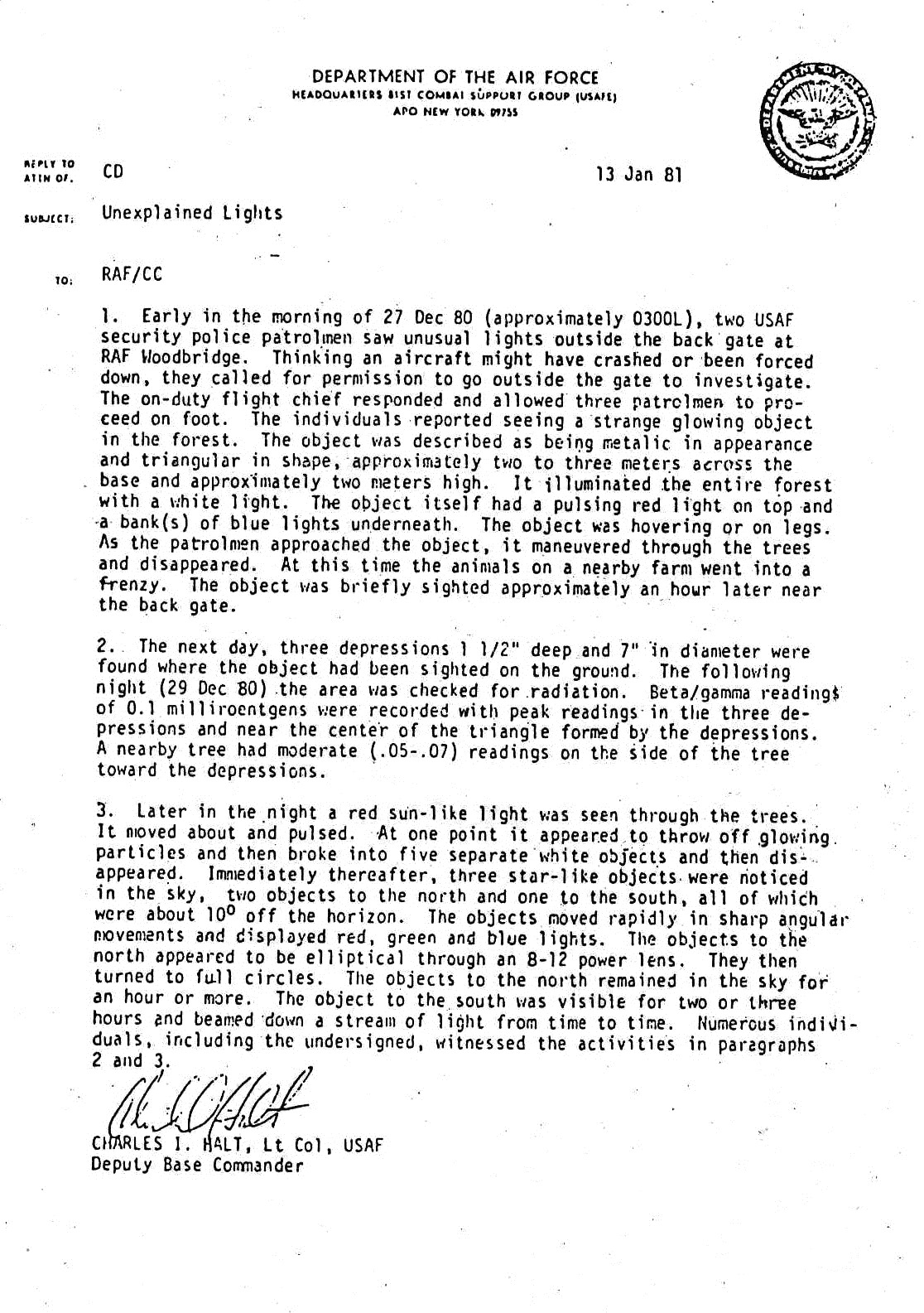
[FACT — as recorded in the memo] Radiation readings were taken at the clearing. The memo records peaks of 0.1 milliroentgens. [CAVEAT] Those readings were taken with a military survey meter not designed for precise low-level measurement of this kind, and later assessments — including by the National Radiological Protection Board — treated their significance with caution. The number is real as a recorded number. What it proves is a separate question, and honest accounts keep those two things apart.
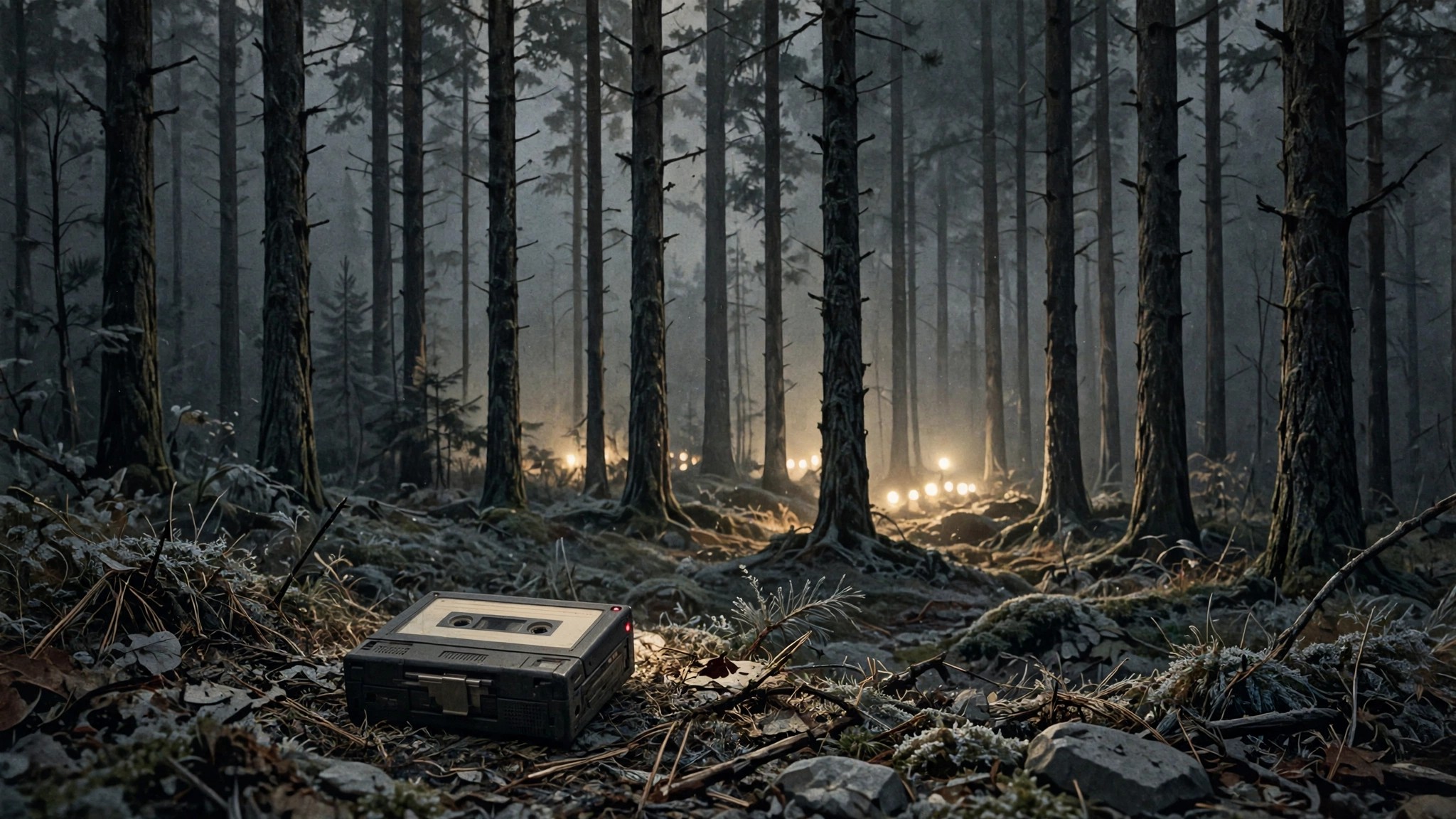
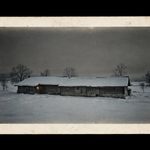
Illustration — a microcassette recorder on the forest floor in Rendlesham Forest, with lights glowing between the trees: the second night, 28 December 1980, as the Halt Tape recorded it. No photograph of the reported object exists; this is an in-house illustration, not evidence.
If you listen to only one primary source in this case, listen to the tape. Then notice what is not on it: no landed craft is described in the terms later retellings use, no symbols are read out, and no message is received. The tape is dramatic enough without additions — which is precisely why the additions that came later deserve dates, not just belief or dismissal.
The memo — and the date it gets wrong
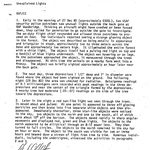
On 13 January 1981, Halt put the incident into the official record in a memorandum headed “Unexplained Lights,” addressed to the British Ministry of Defence. [FACT] The memo is held today at The National Archives under reference DEFE 24/1948. It describes the lights, the reported object, the ground traces and the radiation readings in dry, bureaucratic language — and that dryness is its strength. This is not a press release or a memoir. It is an internal report, written when the incident was an administrative problem, not a famous case.
The memo also contains a small, checkable error that tells you a lot about how to read documents carefully: it misdates both nights by one day, placing the first incident a day later than it occurred. [FACT] The error does not invalidate the memo, and it does not validate the legend either. It simply shows that even the best primary source in a case like this is a human document, written from notes, under time pressure — which is why this series checks documents against each other instead of treating any single one as infallible.
Hold that standard in mind, because it is the whole method of this article: trust the paperwork for what paperwork can prove — that something was reported, by named officers, at the time — and do not ask it to prove more than that.
How the story became public — 1983
For almost three years, the incident stayed inside official files. It became public in 1983, when the Halt memo was released in the United States under the Freedom of Information Act (FOIA). On 2 October 1983, the News of the World ran the story under the headline “UFO LANDS IN SUFFOLK — And that’s OFFICIAL.” [FACT]
Publication changed the case permanently. From 1983 onwards, Rendlesham was no longer only an incident in a file; it was a story that could grow. New witnesses came forward, earlier witnesses remembered more, and the case acquired the elements most people now associate with it. Some of those later elements may contain truth. But they arrived later, and a reader is entitled to know exactly when.
What was added later — every claim, dated
This section is the heart of the case. Each item below is labelled as a claim and dated to when it first surfaced publicly — not to 1980. Labelling is not an accusation of lying. Memory changes, and people can sincerely report what they believe they experienced. But a claim from 2010 is evidence about 2010 as much as about 1980, and it should be weighed that way.
[CLAIM — developed in later accounts] The touch and the symbols. Jim Penniston reported that he approached and touched the object and copied symbols from its surface. His accounts developed over time, and the most detailed versions — including a notebook of symbols — were presented years after the event, not in a contemporary 1980 statement.
[CLAIM — first revealed 2010] The binary code. Penniston later said that after touching the object he received a long sequence of binary digits in his mind, which he wrote down and which, when decoded, was presented as a message giving coordinates and other information. Whatever its origin, it is not part of the 1980–81 record: it entered the public story three decades later.
[CLAIM — later witness account] Entities at Capel Green. Former airman Larry Warren placed himself at a location called Capel Green and reported entities near a craft. His account is not corroborated by the Halt memo or the tape, and other participants have disputed parts of it. It remains his account, and it is presented here as exactly that.
[CLAIM — 2010 affidavit] Radar and official knowledge. In a sworn affidavit, Halt made stronger claims about the incident and about official knowledge of it, including suggestions relating to radar. In a parliamentary answer on 22 July 2015, however, the Ministry of Defence position recorded that its files hold no radar confirmation of the incident. Both statements exist. They do not agree, and no document produced so far settles the point in Halt’s favour on radar.
[CLAIM — 2018, unverified] The SAS-prank letter. A letter attributed to a former SAS soldier suggested the incident was a prank aimed at the Americans. The letter’s provenance has not been independently verified, and no corroborating service record has been produced to confirm it. It is a possible story about the story — nothing more, on present evidence.
Notice what this chronology does. It does not debunk the case. The lights, the tape and the memo remain exactly where they were. What it removes is the false impression that the famous version — craft, symbols, entities, a coded message — was all reported in December 1980. It was not. Roughly half the famous story arrived later, piece by piece, over thirty years.
The explanations, weighed
A case this famous attracts explanations as confidently stated as the claims. They deserve the same discipline: labelled as theory, stated fairly, and tested against what the documents actually say.
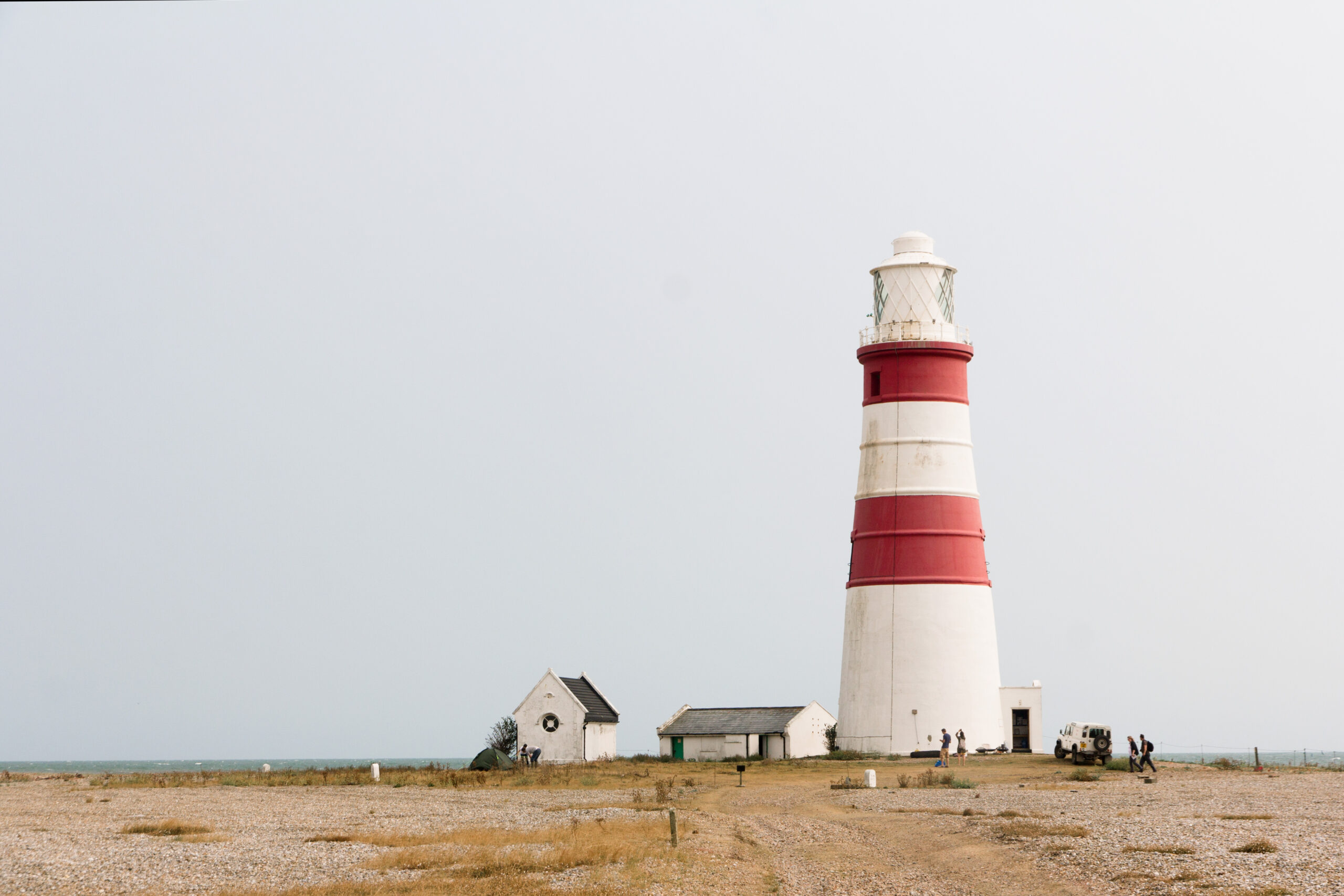
[THEORY — Ridpath] Fireball, lighthouse and stars. Astronomer and investigator Ian Ridpath has argued that a combination of ordinary stimuli explains much of the incident: a bright fireball (meteor) seen in southern England that night, the beam of the Orford Ness lighthouse — about five miles away, sweeping across the forest — and bright stars low on the horizon, which can appear to move as observers move. His reconstruction is the most detailed sceptical account, and it is built from contemporary records, including the tape transcript he published.
[THEORY — Thurkettle] The ground traces. Forester Vince Thurkettle, who worked in Rendlesham Forest, suggested the ground marks were consistent with marks left by forestry work and rabbit activity in a working forest, rather than landing traces. The forest was not a pristine scene; it was a managed woodland, and that context matters.
[ASSESSMENT — NRPB and others] The radiation readings. As noted above, the recorded peak of 0.1 milliroentgens was later treated cautiously, in part because of the instrument used. A recorded reading is a fact about a reading. It is not, by itself, proof of an exotic source.
[FAIR LIMIT] These explanations account well for lights seen at a distance and for much of the second night’s sequence, especially the lighthouse beam’s timing and direction. They account less completely for the first night’s close-range reports by the patrolmen, which remain witness accounts — neither proven nor conclusively explained away. Stating that limit is not a concession to belief. It is the same honesty, applied in the other direction.
What remains unexplained — the honest ledger
Reported (contemporary record)
Plausibly explained
Still unexplained
Lights reported by named USAF personnel on two nights, 26 & 28 Dec 1980
How a lighthouse beam, a fireball and bright stars can produce moving lights in that forest
What the first-night patrolmen encountered at close range
Halt Tape recorded live on the second night
Why later versions of the story are larger than the 1980–81 record
Why no photograph exists if an object was at close range
Halt Memo, 13 Jan 1981 (DEFE 24/1948) — with its one-day date error
Ground marks are consistent with a working forest
Whether the recorded radiation readings have any significance
Ground traces noted in daylight
—
A single explanation that fits every contemporary report at once
The takeaway to remember is simple, and it is the takeaway of the episode as well: the paperwork proves this was reported — by named officers, at the time. It does not prove what it was. A case file can be completely genuine, and still not contain the answer. Rendlesham endures not because it proves visitors from elsewhere, but because it is one of the best-documented unexplained reports of the twentieth century — and because the difference between the file and the legend is a lesson in how every famous mystery grows.
Watch the episode
WATCH — THE UFO A COLONEL TAPED LIVE IN 1980[EMBED: YouTube video URL to be added at launch]The companion episode works through the same evidence on screen: you hear excerpts from the Halt Tape, see the Halt Memo itself, and watch each later claim appear in the year it actually arrived — touch and symbols, the 2010 binary code, Capel Green, the affidavit and the prank letter — weighed against the 1980–81 record.If you came here from the video: the reverse link is live in the video description, which points back to this article as the full case file with sources.
Read next in this series (internal links — add when those articles publish):
Frequently asked questions
What is the Rendlesham Forest incident?
It is a series of unexplained lights — and, on the first night, a reported object — seen by U.S. Air Force personnel near RAF Woodbridge, Suffolk, on the nights of 26 and 28 December 1980. It is documented in a live audio recording and an official memo from January 1981.
What did Colonel Halt record?
Lt. Col. Charles Halt, the deputy base commander, recorded live audio on a microcassette recorder while leading a team into Rendlesham Forest on the night of 28 December 1980. The Halt Tape captures the team calling out lights, times and readings in real time as the incident unfolded.
What does the Halt memo say?
Halt’s memorandum “Unexplained Lights,” dated 13 January 1981 and held at The National Archives (DEFE 24/1948), reports the lights, the reported object, ground traces and radiation readings peaking at 0.1 milliroentgens. It also misdates both nights by one day.
What is the Rendlesham binary code?
It is a sequence of binary digits that witness Jim Penniston said he received after touching the object, first revealed publicly in 2010 — thirty years after the incident. It is a later claim, not part of the 1980–81 documents.
Was it the Orford Ness lighthouse?
That is the leading sceptical theory, advanced by Ian Ridpath: the lighthouse beam, about five miles away, together with a bright fireball and low bright stars, explains many of the reported lights. It explains the second night well; the first night’s close-range reports remain disputed.
Is there a photo of the Rendlesham UFO?
No. No authenticated photograph of the reported object exists. Images presented as the object are illustrations or reconstructions, and in this series they are always labelled as such.
Editor note (do not publish): these six questions and answers map directly to FAQPage schema (JSON-LD) on the published page for rich results and AI-search citation. Keep the wording identical between the visible FAQ and the schema.
Sources and documents
Halt memorandum, “Unexplained Lights,” 13 January 1981 — The National Archives, DEFE 24/1948/1.
Ministry of Defence files on the incident — The National Archives, DEFE 24/1924 and DEFE 24/1995 (including the MoD position statement and witness interview transcripts).
Halt Tape — master transcript published by Ian Ridpath, with voice identification assisted by Charles Halt.
Suffolk Constabulary logs relating to the December 1980 reports.
UK parliamentary answer on radar records, 22 July 2015.
News of the World, “UFO LANDS IN SUFFOLK — And that’s OFFICIAL,” 2 October 1983 (reporting the 1983 FOIA release).
Our editorial standard
Crypt of Mystery labels every claim in this article: FACT for what a named contemporary document shows, WITNESS ACCOUNT for what a named person reported, CLAIM for a later assertion with its year, and THEORY for an explanation offered to account for the record. Any image of the reported object is a labelled illustration or reconstruction, never presented as a photograph. If a source document corrects anything here, we will update this page and note the correction. Corrections are welcomed via the contact page.